Scalable Log Processing System
Designing a high-throughput logging system capable of handling millions of events per day with real-time monitoring and alerting.
Kafka
Elasticsearch
Logstash
Kibana
Distributed Systems
1M+
Logs / Day
99.9%
Availability
<2s
Alert Latency
24/7
Monitoring
Problem
Modern applications generate massive volumes of logs. Traditional systems fail to scale, leading to delayed insights and poor incident response.
- High log volume (1M+ events/day)
- Need real-time processing
- Reliable storage and search
Architecture
The system is designed using a distributed pipeline to ensure scalability and fault tolerance.
- Producers: Applications generate logs
- Kafka: Handles ingestion and buffering
- Logstash: Processes and transforms logs
- Elasticsearch: Stores and indexes logs
- Kibana: Visualization and monitoring
Architecture Diagram
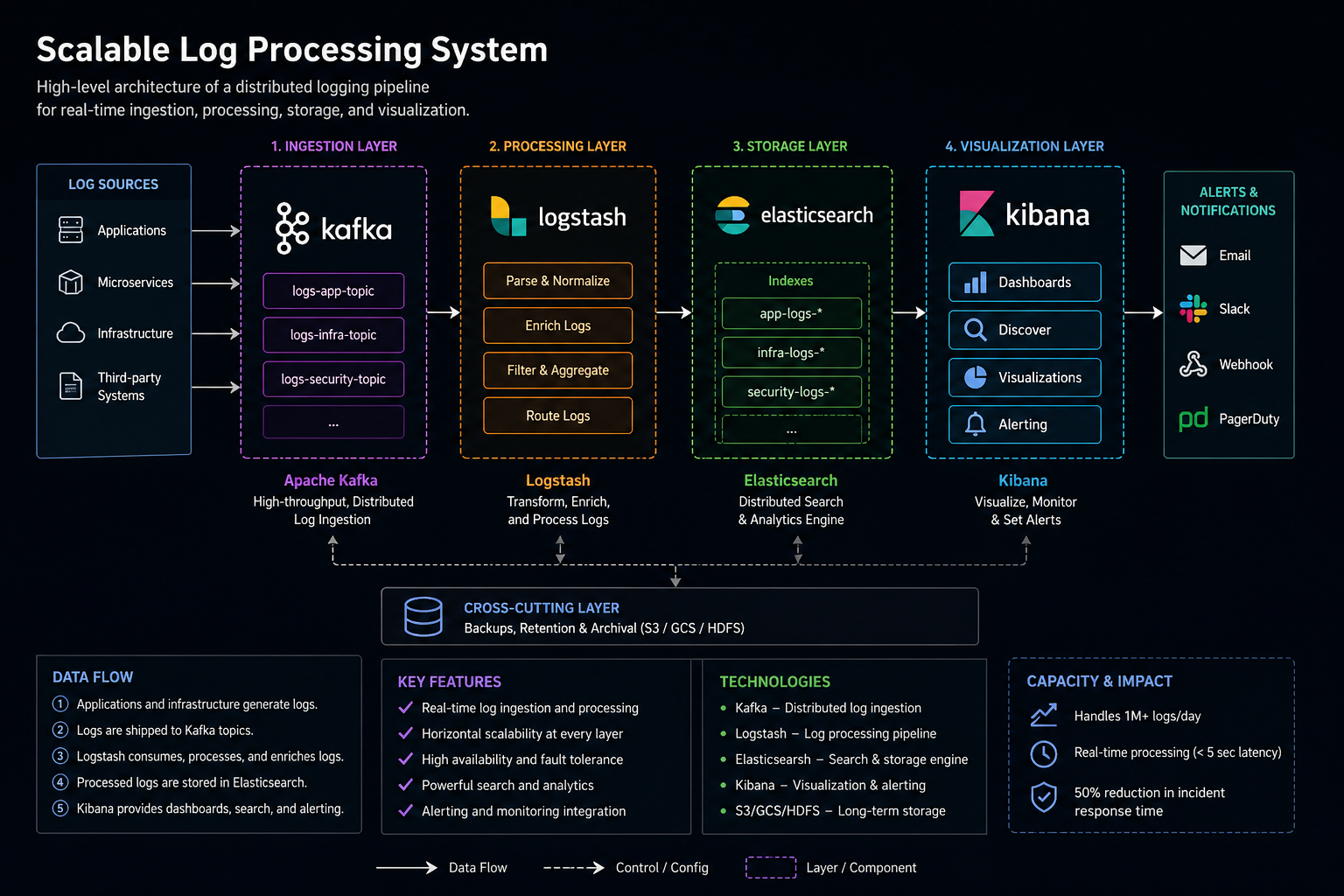
Kafka → Handles ingestion & buffering
Logstash → Transforms logs
Elasticsearch → Index & search
Kibana → Visualization dashboard
Request Flow
Applications
→
Kafka
→
Logstash
→
Elasticsearch
→
Kibana
Scaling Strategy
- Kafka topic partitioning enables horizontal scaling across multiple consumers, allowing parallel log ingestion under high traffic spikes.
- Elasticsearch shards distribute indexing and search workloads across nodes, improving query performance and storage scalability.
- Stateless processing services support auto-scaling and rapid recovery during node failures or traffic surges.
- Load-balanced ingestion pipelines prevent bottlenecks and maintain consistent throughput during peak log generation.
Failure Handling
- Kafka replication across brokers ensures log durability and minimizes the risk of message loss during node failures.
- Consumer groups provide failover capabilities by automatically redistributing partitions when consumers become unavailable.
- Retry and dead-letter queue mechanisms isolate malformed or failed log events without disrupting the ingestion pipeline.
- Centralized monitoring and alerting enable rapid detection of ingestion latency, processing failures, and storage bottlenecks.
Trade-offs
- Kafka improves durability and throughput but introduces operational complexity around partition management and consumer coordination.
- Elasticsearch provides fast indexing and querying capabilities, but requires careful resource tuning to avoid memory and storage overhead.
- Real-time processing improves observability and incident response, while increasing infrastructure cost and operational monitoring requirements.
- Distributed architectures improve fault tolerance, but increase debugging complexity during partial service failures.